The Organization
Overview
No Peace Without Justice is an international non‑profit organisation founded by Emma Bonino and born of a 1993 campaign of the Transnational Radical Party that works for the protection and promotion of human rights, democracy, the rule of law and international justice, and undertakes its work within three main thematic programs.
No Peace Without Justice in Libya
NPWJ has been working on human rights, accountability and transitional justice for Libya since 2011, together with Libyan civil society actors, local human rights defenders and institutional actors.
Through its office in Tripoli, which was shut down temporarily in 2015 due to the political instability and the deterioration of the security conditions but has formally reopened in January 2018, NPWJ has supported dozens of civil society organisations and professionals, including lawyers and judges, in documenting and analysing human rights violations committed by the former regime and during the 2011 revolution, the abuses and violence that continued thereafter and the conditions of detention, and in monitoring local trials. As a result of this support, Libyan NGOs developed the capacity for political initiatives, including conducting awareness campaigns on important legislative initiatives, such as Law 29 /2013 on Transitional Justice, and the Ministerial Decree of 19 February 2014 on Reparations for victims of SGBV.
The political crisis that began in mid-2014 blocked the implementation of these legislative initiatives and the development of a transitional justice process that could lead to national reconciliation. However, the fact that these legislative instruments were adopted in response to the political mobilisation of local advocacy organisations was, even then, a sign of the capacity and ambition of women, men and young people, organised both formally and informally, to contribute to democratic change. Until the latest crisis (2014), these actors were also able, at least at the local level, to act as a check on the power of some of the militias that were beyond the control of the central government.
In addition to civil society campaigns, NPWJ has worked with the Ministry of Justice and its Higher Judicial Training Institute in providing training and expertise to the judges and prosecutors who were charged with the enormous task of dealing with those suspected to have committed or directed atrocities during the conflict and during the previous regime. NPWJ seconded an experienced war crimes prosecutor to the Office of the Prosecutor of Misurata to assist in clearing a large backlog of cases that had contributed to unsustainable conditions of detention. NPWJ has also worked with the legal profession to organise colloquiums about Libya’s transitional justice process and judicial reform. NPWJ organised outreach campaigns on transitional justice across Libya, including various editions of “Youth Day”, organised in collaboration with the Libya Youth Union. NPWJ has organised several workshops and trainings with civil society on various aspects of transitional justice and human rights, including on the human rights of women, children, minorities and other vulnerable groups, including in Benghazi, Houn, Misurata, Sebha, Sebrata, Tobruk Tripoli, Yefren and Zawia, working with local groups and activists in each of these areas.
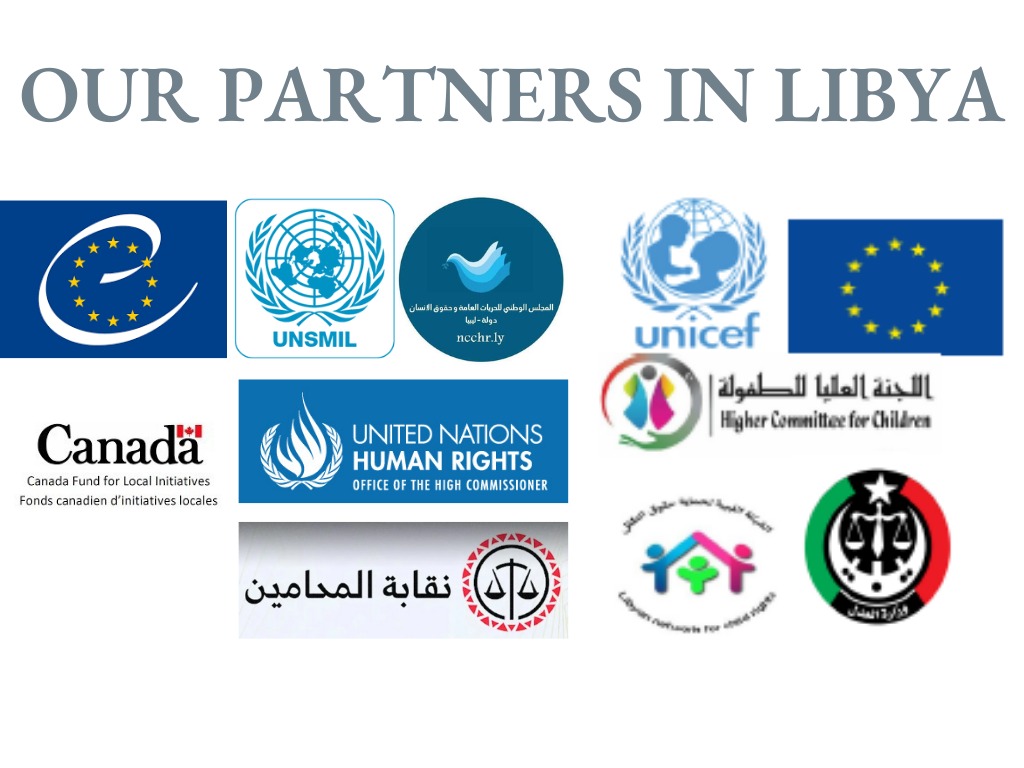
In 2018, No Peace Without Justice has resumed its operations in Libya in partnership with UNICEF, working in particular on the Rights of the Child. NPWJ is currently working on the promotion of an enabling legal environment for children in Libya. In that sense, some activities were developed focusing on the need for capacity building, with two major target groups: civil society organisations on the one hand, and government institutions and independent national institutions on the other hand. This is particularly important since progress related to the protection of children’s rights requires coordinated action between CSOs, NGOs, institutions and national authorities, mainly through the implementation of joint programs.
Building on the success of this experience with UNICEF, NPWJ launched, in August 2020, an ambitious program that would allow the government to prepare and submit its various overdue reports to the different human rights treaty bodies and to initiate an inclusive national debate on many sensitive human rights issues with financial support from the European Union. In the framework of this program, NPWJ will support the efforts of the Libyan Government to establish a permanent inter-ministerial national mechanism for the drafting of periodic reports and follow-up of the TBs recommendations as a National Mechanism for Reporting and Follow up (NMRF), according to the guidelines of the United Nations. NPWJ will assist the NMRF in the collection and analysis of all relevant information, to enable the Libyan Government to fulfil its obligations to the Human Rights Treaty Bodies, as well as to other regional and international mechanisms, and to build the capacities of the Libyan Government in this area. The same program will also benefit civil society organisations.
Methodology
Our approach in Libya and elsewhere is based on the principles of national ownership and national leadership. We don’t replace national actors. We support them, from a human rights principled perspective, and accompany their efforts to reach their objectives. The political developments since the Berlin Summit (January 2020) and the recent political dialogue in Tunis (November 2020) give us hope that our action in Libya will bear fruit in the near future and that human rights will gain importance and priority, especially now that Libya has been elected as a member of the UN Human Rights Council and went through the Universal Periodic Review.